
When The Pokémon Company experiments, it rarely does so halfway. After exploring open-world design and real-time mechanics in recent entries, the franchise is now stepping into an entirely different space: the cozy life simulation genre.
Enter Pokémon Pokopia, launching March 5 exclusively on Nintendo Switch 2. At first glance, it looks like Pokémon’s answer to Animal Crossing: New Horizons — a bright, laid-back world filled with crafting, decorating, and charming creatures. But after spending time with the game in a hands-on preview, it’s clear that Pokopia isn’t simply following Nintendo’s life-sim blueprint. Beneath its relaxed surface lies something far more systems-driven — and surprisingly puzzle-focused.
A Familiar Setup — With a Twist
Pokopia opens in classic Pokémon fashion: a lengthy, text-heavy introduction designed to ease players into its world. You play as a Ditto who misses its absent trainer so deeply that it transforms into a customizable human-like version of them. Soon after, you meet Professor Tangrowth, who reveals a strange mystery: all the human trainers have vanished.
From there, you’re released into a blocky, colorful landscape that feels like Pokémon filtered through a sandbox-building game. Early mechanics echo the life-sim staples players know well. You collect materials like sticks and stones, craft furniture at a workbench, and place decorations freely across the map. There are daily challenges that reward currency, unlocking new items and recipes. Even the inventory interface feels intentionally familiar.
But that’s where the comparisons start to fade.
Habitat Building Is the Real Core
Rather than focusing purely on decorating or socializing, Pokémon Pokopia revolves around environmental problem-solving.
The central gameplay hook? You don’t catch Pokémon — you create the conditions for them to appear.
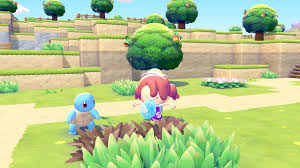
Early on, you encounter a dehydrated Squirtle lying helpless on the ground. As a Ditto, you copy its Water Gun ability and use it to revive it. Squirtle then teaches you how to use that move on dried grass, transforming it into “tall grass” — the kind of habitat that attracts Bulbasaur.
Bulbasaur introduces Leafage, which grows more grass. Combine that with Water Gun, and you generate even denser terrain, eventually attracting Charmander. Each Pokémon becomes part of an interconnected environmental chain reaction.
Instead of battling creatures to weaken and capture them, you’re solving ecological puzzles to invite them in.
TMs Become Tools for Exploration
As you progress, Pokopia expands beyond simple grass-and-water interactions. Abilities function like a growing toolkit of TMs. Within the first hour, you unlock moves such as:
- Rock Smash to break stone barriers
- Cut to clear thick logs
- Additional abilities that reshape the world in creative ways
These moves are assigned to a customizable quick menu and radial wheel for easy access. They consume a small amount of PP, which you replenish by eating food — a light survival element that adds just enough resource management without becoming stressful.
To unlock new Pokémon (and their abilities), you must solve habitat clues scattered throughout the world. For example, Hitmonchan only appears in a proper training area. A clue might hint at placing a punching bag next to a bench — which means gathering specific materials and crafting the right setup.
In many ways, it feels like a softer, more creative extension of Pokémon’s traditional type-guessing puzzle: observe, interpret, experiment.
A World That Grows With You
Once a Pokémon appears, it doesn’t just vanish into storage. Each one becomes a resident of your evolving world.
Every Pokémon has a comfort level that increases through gifts and completed requests. During the demo, I encountered an Arcanine living in a cozy cottage. It wanted something warm added to its home — perhaps a crafted campfire (though maybe don’t try that in real life).
Each habitat effectively becomes a personalized home you can decorate, refine, and expand. It’s part life sim, part ecosystem management, and part collection log, with a Pokédex-style catalog tracking discovered habitats.
Multiplayer Raises Bigger Questions
In a multiplayer session set in a location called “Palette Town” (not Pallet Town), four players were free to collaboratively build and experiment.
I focused on attracting the right Pokémon to construct a Poké Center, where healing and item cloning become possible. Meanwhile, another player gleefully smashed structures I was still building. Cooperation? Chaos? A little of both.
The big question remains: is there a larger shared objective? Or does multiplayer lean fully into sandbox freedom? The preview left that unclear, though scattered journal pages hint at a broader mystery surrounding the missing humans — potentially serving as the game’s narrative backbone.
More Builder Than Animal Crossing?
While many comparisons point to Animal Crossing, Pokopia arguably feels closer to sandbox-builder hybrids like Dragon Quest Builders or even Viva Piñata, where environmental design directly influences which creatures arrive.
Yes, it has cozy vibes. Yes, it has decorating and daily challenges. But its identity is rooted in structured environmental logic and progression systems rather than purely social simulation.
And that distinction matters.
A Different Kind of Pokémon Fantasy
Pokémon Pokopia seems tailored for fans who love the creatures but aren’t fond of constant battling. It’s about coexistence instead of competition — building spaces where Pokémon thrive rather than forcing them into combat.
Whether the full game delivers a satisfying endgame loop remains to be seen. But one thing is already clear: this isn’t just Pokémon wearing an Animal Crossing costume.
It’s Pokémon reimagined as a creative ecosystem puzzle — and that’s far more interesting.
Leave a Reply