Unraveling Nolan’s Odyssey: Is Athena a Divine Guide or a Ghost of Guilt?
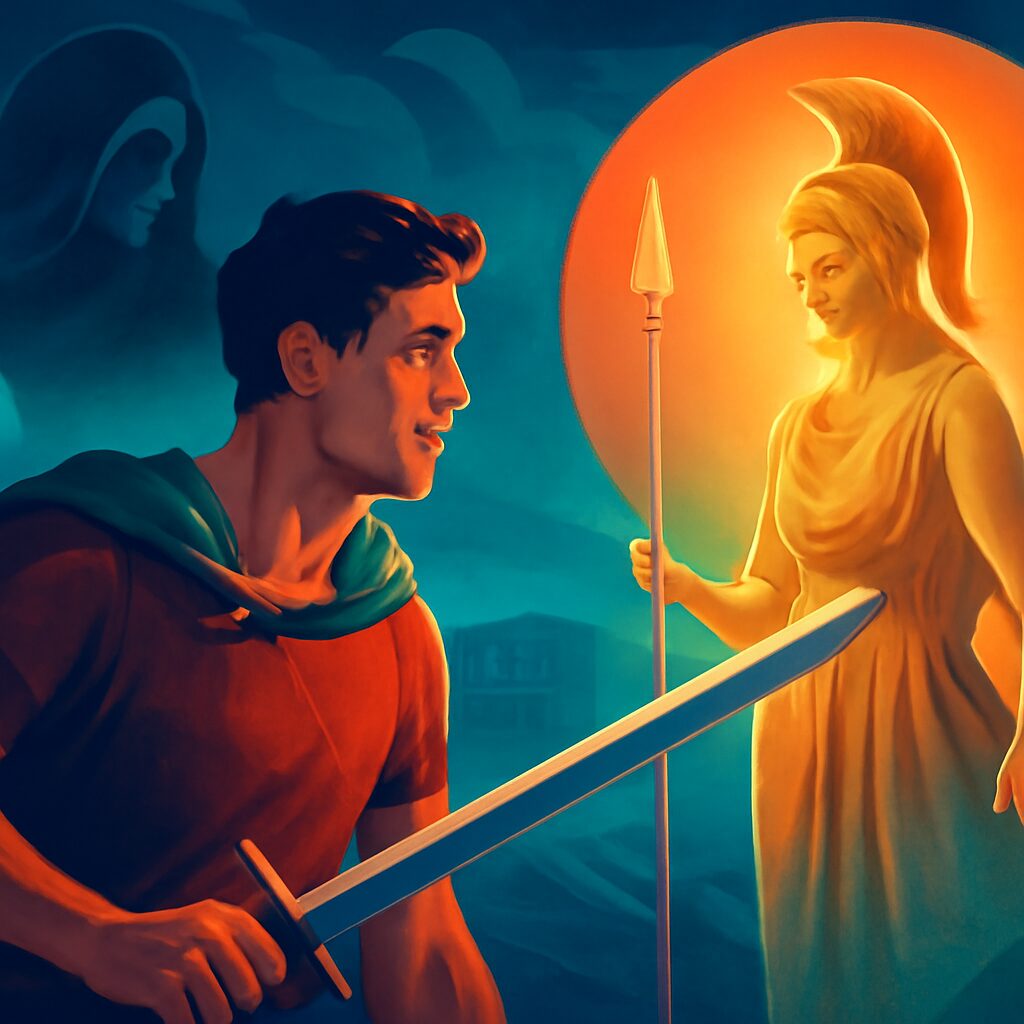
Alright, gamers and movie buffs, let’s dive into a cinematic discussion that’s been making waves since Christopher Nolan dropped his epic take on *The Odyssey*. We’re talking about a debate that’s got everyone scratching their heads and theorizing: just how real was Zendaya’s portrayal of Athena?
For those familiar with Homer’s ancient poem, Athena is a pretty significant figure. She’s Odysseus’s divine mentor and protector, appearing in various forms to guide him on his arduous journey home to Ithaca. She’s the one who helps him disguise himself as an old man, allowing him to scope out the situation before revealing his true identity and reclaiming his kingdom. Basically, she’s a goddess who actively intervenes to help her favorite mortal hero.
Now, Nolan, being Nolan, brought his signature ambiguity to the character. In his film, Athena certainly appears as a protective figure by Odysseus’s side. However, there’s a huge twist: she takes on the face of a priestess, a woman tragically beheaded by Odysseus’s men during the siege of Troy. This choice immediately throws a wrench into the straightforward “divine protector” narrative.
The core of the debate boils down to two main camps. On one side, many viewers argue that Nolan’s Athena is largely a manifestation of Odysseus’s profound guilt. After all, she only appears to him, and her form is a constant reminder of a past atrocity. It’s easy to see how his conscience, burdened by the horrors of war and his actions, could conjure such an image.
But then there’s the other side, equally compelling. Proponents of a “real” Athena point out that in Greek mythology, gods often interacted with humans on a very personal, one-on-one level, often making themselves visible only to their chosen few. Why couldn’t Athena, a goddess known for her cunning, simply choose a form that would both aid and subtly torment Odysseus, making him confront his past while still providing guidance? Some fans also highlight moments where Athena seems to impart knowledge Odysseus couldn’t possibly have known otherwise, suggesting a source beyond his own mind.
It’s classic Nolan, really. He loves leaving things open to interpretation, making the audience do the heavy lifting. One viewer astutely pointed out that this ambiguity might be the key to understanding the movie’s opening line about “a time of apparent magic.” Was the magic truly supernatural, or was it all in the mind of a war-weary hero grappling with his demons?
Ultimately, whether Nolan’s Athena is a true goddess, a figment of guilt, or perhaps even a fascinating blend of both, is a question left for you to ponder. What do you think? Did Odysseus have a divine guardian, or was he wrestling with his own internal demons? Let us know your take!
As an Amazon Associate, PakGamersHub earns from qualifying purchases.