Voyager 1: Humanity’s Ultimate Ping Reaches a Full Day, A Cosmic Milestone
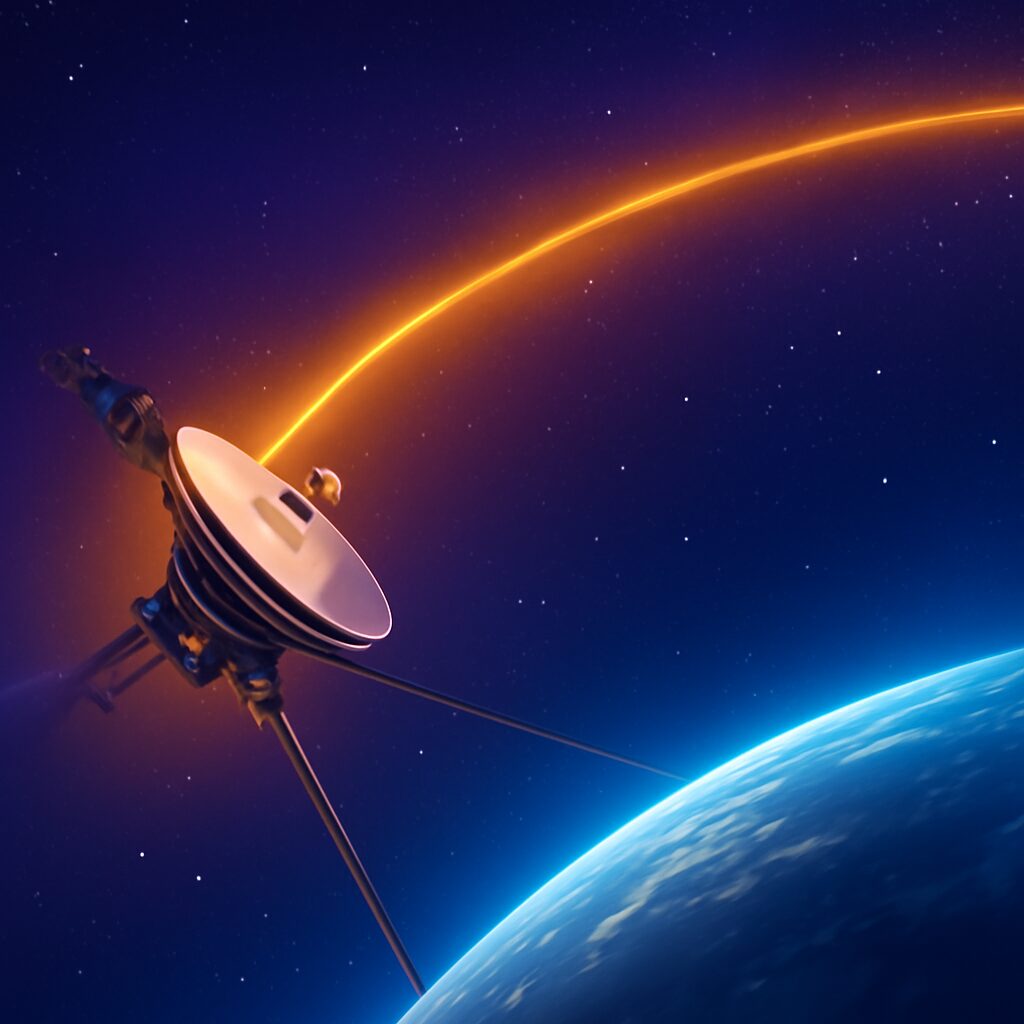
Imagine hitting a ping so high it takes a full 24 hours for your signal to even reach the server. While that would be a nightmare for any online gamer, for humanity’s farthest traveler, NASA’s legendary Voyager 1 spacecraft, it’s about to become a mind-boggling reality and an incredible testament to human ingenuity.
This isn’t just a technical achievement; it’s a profound marker in our species’ quest to explore the cosmos. Voyager 1, launched over four decades ago, is set to achieve a monumental milestone, becoming the first human-made object to reach a staggering “one light-day” from Earth.
The Epic Journey Continues
To truly grasp the significance of this upcoming feat, we need to rewind to 1977. That’s when Voyager 1, alongside its twin Voyager 2, embarked on what was initially planned as a five-year mission to study Jupiter and Saturn. These probes were equipped with cutting-edge (for the 70s!) technology and sent on a grand tour of the outer solar system.
But Voyager 1, like a seasoned player refusing to quit a game, kept going. After dazzling us with unprecedented close-ups of gas giants and their moons, it was directed upwards, out of the plane of the planets, towards the uncharted territory beyond our solar system. In 2012, it officially crossed into interstellar space, a cosmic frontier no human creation had ever touched.
For over 46 years, this resilient little spacecraft has been pushing the boundaries of exploration, sending back invaluable data from a region of space we could only dream of reaching. It’s a true endurance run, making it one of the longest-running and most successful missions in NASA’s history.
What Does “One Light-Day” Really Mean?
The term “one light-day” might sound abstract, but its implications are stark. It means that by November 18, 2026, at approximately 10:16:07 UTC, Voyager 1 will be so far away that a signal traveling at the speed of light – the fastest anything can go in the universe – will take a full 24 hours to reach it. And another 24 hours for any response to get back to us!
At that incredible distance, Voyager 1 will be approximately 25.9 billion kilometers (or roughly 16.1 billion miles) from our home planet. To put that into perspective, it’s more than 170 times the distance from the Earth to the Sun. It’s a scale that truly boggles the mind, making every pixel of data an ancient whisper from the void.
For gamers, think of it as the ultimate lag. Every command, every bit of data sent, is subject to a 48-hour round trip. It highlights not just the vastness of space, but the incredible precision and patience required to communicate with our distant ambassador.
Whispers Across the Void: The Challenge of Communication
Maintaining contact with Voyager 1 is nothing short of a miracle. The signals it sends back are incredibly faint, weaker than the power emitted by a smartphone’s Wi-Fi signal. These whispers are painstakingly captured by NASA’s Deep Space Network (DSN), a global array of massive radio antennas strategically placed across the Earth.
The DSN acts like the universe’s most sensitive ear, listening for these faint calls from billions of miles away. It’s a testament to the engineers and scientists who’ve kept the mission alive, constantly finding innovative ways to squeeze every last bit of data from the aging probe. The data transfer rates are laughably slow by modern standards, sometimes just tens of bits per second, but every bit is a treasure from beyond.
As Voyager 1 travels further, its instruments and power sources continue to degrade. It operates on a tiny amount of power generated by a radioisotope thermoelectric generator (RTG), which uses the heat from decaying plutonium to produce electricity. This power source has been steadily weakening for decades, meaning fewer instruments can be kept active, and the communication becomes even more challenging.
A Message in a Bottle: The Golden Record
Beyond its scientific instruments, Voyager 1 carries a unique piece of humanity into the cosmos: the Golden Record. This 12-inch, gold-plated copper phonograph record is essentially a time capsule, intended as a message to any intelligent extraterrestrial life that might one day encounter the spacecraft.
The contents of the Golden Record were carefully curated by a team led by Carl Sagan, aiming to broadly represent life and culture on Earth. It includes:
- Sounds of Earth, such as crashing waves, a baby’s cry, and animal sounds.
- Musical selections from various cultures and eras, including classical and folk music.
- Spoken greetings in 55 ancient and modern languages.
- 116 images encoded in analog format, depicting scientific explanations, human anatomy, and scenes of Earth’s flora and fauna.
This record serves as a cosmic “hello” from humanity, a hopeful gesture that our curiosity and creativity might one day be understood by another civilization. It’s a reminder that even as we explore the universe, we’re also leaving our mark, sending a piece of ourselves into the vast unknown.
The Road Ahead for Our Distant Explorer
Voyager 1 continues its solitary journey, collecting data on magnetic fields, cosmic rays, and plasma waves in interstellar space. While its instruments are slowly powering down, it’s expected to continue sending back some form of data until the mid-2020s, possibly even into the 2030s, as engineers stretch its lifespan to the absolute limit.
Eventually, the power will run out, and Voyager 1 will go silent, becoming a permanent, silent ambassador for Earth, drifting endlessly through the Milky Way galaxy. It won’t be heading towards any particular star, but its trajectory will carry it beyond our solar system, a testament to human ingenuity and our unyielding desire to reach for the stars.
The upcoming “one light-day” milestone is more than just a number; it’s a powerful symbol of humanity’s boundless curiosity and our capacity for innovation. It reminds us that even in the ultimate open-world game of space exploration, there are always new horizons to reach, new records to break, and new secrets to uncover, inspiring generations of gamers and scientists alike to look up and dream big.