Xbox’s New Disc-to-Digital Feature Could Give Delisted Games a Second Life
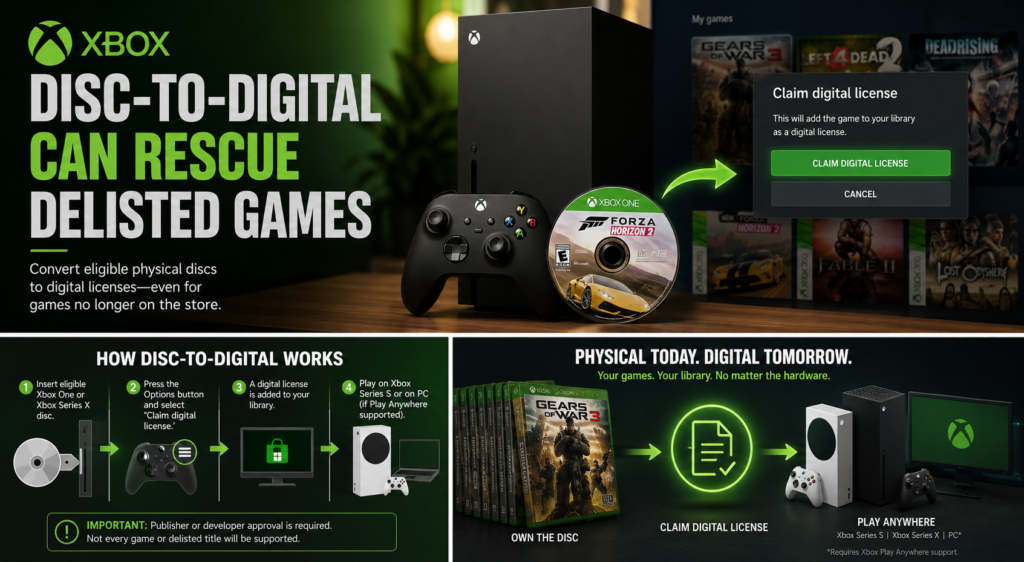
Microsoft is testing a new Xbox feature that could make physical game collections significantly more useful, especially for players who own titles that have disappeared from digital storefronts.
The new disc-to-digital system allows eligible physical Xbox games to be converted into digital licenses. Even more interestingly, early testing by Xbox Insiders suggests that the feature can work with some delisted games — titles that can no longer be purchased through the Xbox Store.
For game preservation and physical collectors, this could be a surprisingly important addition to the Xbox ecosystem.
How Xbox Disc-to-Digital Works
The feature is currently being tested through the Xbox Insider program.
Players with a supported Xbox One or Xbox Series X game disc can insert the disc into a console with a disc drive and use a new option to claim a digital license.
Once the license has been successfully claimed, the game becomes part of the player’s digital Xbox library rather than remaining accessible only through the physical disc.
That opens up an important possibility: playing a game originally purchased physically on an Xbox Series S, despite the Series S having no disc drive.
For games supporting Xbox Play Anywhere, the digital license may also provide access on PC. However, PC support is dependent on the individual game supporting Play Anywhere.
The Big Surprise: Delisted Games Can Work
The most interesting discovery from early testing is that a game apparently doesn’t necessarily need to remain available for purchase on the Xbox Store for the conversion to work.
Some games disappear from digital stores because of expired licensing agreements, music rights, publisher decisions or other contractual issues. Physical copies can continue to exist long after the digital version has stopped being sold.
Traditionally, that means owning the disc doesn’t help much if your newer hardware doesn’t have a disc drive.
Xbox’s disc-to-digital system could change that.
If a supported delisted game is already sitting on your shelf, you may potentially be able to use that physical copy to establish ownership and receive a digital license.
In other words, Microsoft doesn’t necessarily need to start selling the game again for an existing physical owner to gain digital access.
This Doesn’t Mean Every Xbox Disc Will Work
There is one major limitation.
Publishers and developers appear to have control over whether their games participate in the program. That means players shouldn’t assume that every Xbox One or Xbox Series X disc can automatically be converted.
The same applies to delisted games.
One publisher could allow its older games to participate while another could decide against it. Compatibility will therefore depend heavily on which companies support Microsoft’s system.
Players testing the feature are already compiling community compatibility information as more discs are tried.
Physical Xbox Games Just Became More Interesting
The feature could also change the value proposition of owning physical games.
The industry has increasingly moved toward digital distribution, while consoles such as the Xbox Series S have removed the optical drive entirely. One disadvantage of that transition is that a player’s existing physical collection becomes much less useful on digital-only hardware.
Disc-to-digital potentially creates a bridge between the two formats.
A physical disc effectively becomes proof that you own the game, allowing Microsoft to grant a digital license when the title and publisher support the system.
That means an old game sitting on a shelf could potentially follow a player onto newer digital-only Xbox hardware.
It Could Also Help With Game Preservation
There is also a broader game-preservation angle.
Delisting has become an increasingly visible problem as games disappear from online stores. Licensed music, cars, sports organizations, characters and other third-party content can all contribute to games eventually being removed from sale.
Once that happens, people who already bought the game digitally generally retain access, but new players may have no legal way of obtaining a digital copy.
Physical copies provide one of the remaining ways of preserving access to those games.
Allowing those discs to unlock digital versions won’t solve the entire preservation problem, particularly because publisher participation is still required, but it could make existing physical copies considerably more useful.
Instead of being limited to consoles with compatible optical drives, supported games could continue living inside a player’s digital library.
Xbox Series S Owners Could Be Among the Biggest Winners
Xbox Series S owners arguably have the most to gain.
The Series S is completely digital, meaning there has traditionally been no way to use an Xbox disc with the console. Someone upgrading from an Xbox One with dozens of physical games therefore couldn’t simply bring that physical library with them.
Disc-to-digital could provide a solution.
Players could potentially use an Xbox One or Xbox Series X with a disc drive to verify supported physical games and then access the resulting digital licenses on their Series S.
It makes Microsoft’s digital-only console considerably friendlier to players who built physical Xbox collections over the years.
PC Support Has an Important Limitation
The feature could extend beyond Xbox consoles as well, but PC players shouldn’t expect every converted disc to suddenly become a PC game.
PC access depends on Xbox Play Anywhere support.
If the game supports Play Anywhere, an eligible digital license could allow the title to be played across Xbox and PC. Games without that functionality won’t automatically gain PC compatibility simply because their physical copy was converted.
The Feature Is Still Being Tested
Microsoft has not yet rolled the system out universally.
Disc-to-digital entered testing with Xbox Insiders on August 31, meaning Microsoft can still modify how the system works before releasing it to the broader Xbox community.
Compatibility requirements, regional restrictions, publisher participation and the handling of unusual cases involving older or delisted games could all evolve during testing.
Still, the fact that players are already successfully experimenting with delisted titles makes the feature much more interesting than a simple physical-to-digital conversion system.
A Major Win for Physical Game Collectors
Physical media isn’t suddenly replacing digital distribution, but Microsoft’s approach could give physical Xbox games an unexpected advantage.
A disc would no longer necessarily be useful only while you own hardware capable of reading it. Instead, supported discs could act as a permanent bridge into Microsoft’s digital ecosystem.
And for delisted games, that could be especially valuable.
There are countless Xbox games that can no longer be purchased digitally but still have physical copies circulating among collectors and second-hand markets. If publishers allow those games into the program, some titles effectively locked to older disc-based hardware could become playable on newer digital-only systems.
The feature isn’t a complete solution to digital game preservation, and publisher participation remains a major limitation.
But allowing a physical copy of a delisted game to unlock legitimate digital access is a meaningful step — and it could give Xbox collectors another very good reason to hold onto their discs.
As an Amazon Associate, PakGamersHub earns from qualifying purchases.